Dinner decision fatigue: how to make dinner easier
Dinner decision fatigue often peaks at the end of the day when one more open-ended choice feels expensive.
The fastest relief comes from deciding earlier and keeping the weekly plan visible before dinner hour starts.
14-day trial, no card required.
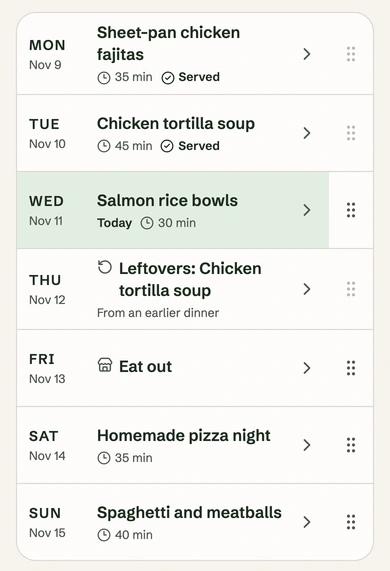
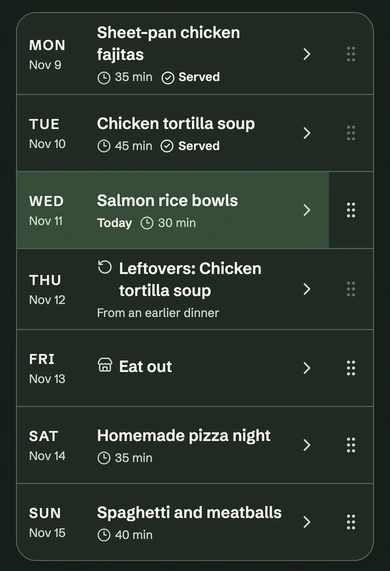
For a deeper explanation of this pattern, read the full dinner decision fatigue guide.
What dinner decision fatigue actually is
Dinner decision fatigue is the nightly drop in decision bandwidth after a full day of choices.
It is a structure issue, not a motivation issue.
When dinner is still open at 5 p.m., the brain treats one more decision as expensive and often delays action.
That delay creates the exact rush that makes decision quality worse.
If this feels familiar, the dinner freeze breakdown explains why this decision can feel bigger than it looks.
Why dinner feels harder at the end of the day
The 5 p.m. window combines lower energy, time pressure and household coordination.
When dinner is still undecided at that point, friction rises fast.
Even a good recipe list does not help if the week was never committed in advance.
Reducing nightly choice load is the fastest lever for calmer evenings.
If ADHD is part of your household context, this related page on meal planning with ADHD focuses on executive-function-specific friction.
Sound familiar in your week?
- Before
- 5 p.m. arrives and dinner is still an open-ended decision.
- After
- Dinner is settled earlier, tonight is visible and evenings run with less last-minute friction.
Put this idea into one shared weekly Plan.
Start freeWhy saved recipes and loose ideas do not solve it
Saved recipes are inspiration, not execution.
Without a committed weekly plan, a large recipe list adds more choices at the hardest time.
Households often mistake collection progress for planning progress.
Relief comes when dinner is already decided before evening decisions stack up.
If this is your main blocker, the page on saved recipes but no dinner plan walks through turning stored ideas into a usable weekly plan.
How to make dinner easier with fewer nightly decisions
Plan 5 to 6 dinners in one sitting and build from a repeatable dinner pool.
A list of 8 to 10 dinners you already make is enough to start. Planning gets easier as the list grows.
Use the weekly view as a commitment tool so the hardest decision is made before dinner hour.
Then use quick swaps instead of restarting decisions from scratch each night.
How MealPlanned helps take pressure off dinner
MealPlanned helps you settle dinner earlier with a visible weekly plan and dinner history that supports faster weekly fill.
The current-week Plan works with any non-empty Rotation.
Premium adds optional smarter suggestions, custom Week patterns and extended history.
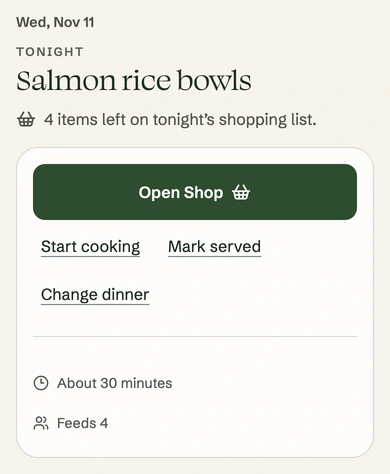
The household can see tonight at a glance, which lowers friction when energy is already low.
This flow is built for nightly decision overload, so the product focus stays on reducing live choice-making at dinner time.
What the product supports
Tonight is visible before evening
A clear tonight plan removes the hardest end-of-day decision before decision bandwidth runs out.
A reviewable current-week Plan
Free includes Plan for the current and next week. Premium adds optional smarter suggestions, custom Week patterns and extended history.
Dinner history saves repeated thinking
Use dinner history and recency cues to avoid rerunning the same decision loop every night.
Frequently asked questions
What is the fastest way to reduce dinner decision fatigue this week?
Plan 5 to 6 dinners in one sitting and settle tonight's dinner before late afternoon.
That shift removes the hardest real-time decision from the evening window.
How many regular dinners do we need to reduce nightly friction?
Start with 8 to 10 dinners your household already eats.
As more favorites join your Rotation, planning the week gets quicker and more flexible.
Does the current-week Plan require a large Rotation?
The current-week Plan works with any non-empty Rotation.
It performs better when the household has a broader repeatable dinner pool.
Related reading
Start with the dinners your household already knows.
14-day trial, no card required.